Personal Finance · Wealth Management
Strategic Wealth Management for Global Investors: The Definitive Guide to Long-Term Prosperity
Master strategic wealth management for global investors with 20+ years of insights. Build a resilient portfolio and secure long-term financial growth with GIR.
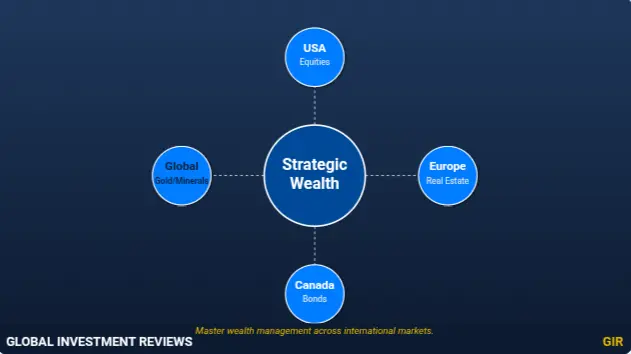
Strategic wealth management for global investors is not a product of luck or market timing; it is a discipline born from the scars of experience. Over the past twenty years, I have navigated the volatile corridors of global finance—from the early 2000s tech bubble to the 2008 housing crash, and now into the complex, high-interest-rate environment of 2026. If there is one fundamental truth I have learned as a portfolio manager, it is that capital preservation is the silent engine of long-term wealth.
For investors residing in the USA, Europe, and Canada, the current financial landscape presents a dual-edged sword. On one hand, you have access to the most liquid markets in the world; on the other, you are navigating a maze of sophisticated tax laws and geopolitical shifts. To thrive, you need more than just a brokerage account—you need a cohesive, cross-border strategy that ensures your financial success roadmap for 2026 remains intact despite market turbulence.
The Evolution of Global Markets: Why Strategy Must Come Before Assets
Two decades ago, a simple "buy and hold" strategy for domestic stocks was often sufficient. Today, globalization and digital transformation have interconnected every economy. A ripple in the European energy sector or a policy shift in Washington D.C. can impact a Canadian retirement fund overnight. My approach to strategic wealth management for global investors focuses on proactive architecture rather than reactive adjustment.
1. Dynamic Asset Allocation: Beyond the 60/40 Rule
A 60/40 stock-and-bond portfolio is one familiar allocation framework, not a universal rule and not automatically obsolete. Its suitability depends on valuation, inflation, interest rates, time horizon, liabilities, tax status and the investor’s capacity for loss. Alternatives such as real estate, commodities or inflation-linked securities introduce their own costs, volatility and concentration risks; they are not mandatory for every investor. The SEC’s Investor.gov guide to asset allocation explains why allocations should reflect individual goals, time horizon and risk tolerance.
Illustrative allocation example—not a recommendation: Any sample portfolio weights shown in articles are hypothetical teaching examples only. They should not be interpreted as a GIR model portfolio or as suitable for every reader. A real allocation must account for the investor’s jurisdiction, tax position, goals, liabilities, time horizon, risk tolerance and existing holdings. Cash has inflation risk, gold can be volatile, and bonds can lose value when yields rise.
2. Jurisdictional Tax Intelligence: What You Keep Matters
In the USA, tax-loss harvesting and the utilization of IRAs/401(k)s are fundamental. In Europe and Canada, the focus often shifts to cross-border tax treaties. Tax treatment can materially affect net returns, but the effect depends on the investor’s residence, account type, asset, holding period and applicable treaties. Do not assume a universal percentage reduction; obtain jurisdiction-specific tax advice and model after-tax outcomes. A truly strategic global investor works closely with tax experts to ensure that geographical diversification doesn't lead to double taxation.
3. Macro-Economic Awareness: The Global Compass
Successful wealth management requires a "Top-Down" analysis. We don't just look at a company's balance sheet; we look at the global liquidity cycle. By monitoring the Federal Reserve’s interest rate trajectory and the IMF’s global growth forecasts, we can adjust our "Portfolio Beta" to protect capital before the market turns.
Insights from Two Decades in the Trenches
Many investors ask me: "What is the secret to staying wealthy?" The answer is simpler than most expect, but harder to execute. It is behavioral discipline. During the 2008 crisis, the investors who panicked and liquidated their positions lost the most. Those who viewed the crash as a "fire sale" on high-quality assets are the billionaires of today.
"The real key to making money in stocks is not to get scared out of them."
— Peter Lynch, Famed Fund Manager.
At Global Investment Reviews (GIR), we emphasize that 2026 is the year of the "Thinking Investor." With AI-driven algorithms creating massive short-term volatility, your edge lies in your ability to look five to ten years ahead. High-frequency trading may dominate the minutes, but strategic vision dominates the decades.
The Role of Sustainable and ESG Investing
Modern wealth management is also increasingly tied to sustainability. Institutional investors in Europe are leading the charge, but North American investors are quickly catching up. Incorporating Environmental, Social, and Governance (ESG) factors is no longer just "ethical"—it is a risk-mitigation strategy. Companies that ignore their environmental footprint are facing increased regulatory costs and litigation risks, which directly impacts their long-term stock performance.
My Professional Advice: Building Your Financial Fortress
A practical liquidity reserve can reduce the chance that an investor must sell long-term assets to cover near-term expenses during a market downturn. The appropriate amount depends on income stability, household spending, insurance, debt, dependants, portfolio liquidity and foreseeable capital calls. A two-year cash reserve is not a universal rule; investors should model their own cash-flow needs and consider the trade-off between liquidity, inflation and long-term returns.
Strategic wealth management is like planting an oak tree. If you keep digging up the roots to see how they are growing, the tree will die. Automate your contributions, diversify your geography, and most importantly, stay informed through reputable sources like Forbes Advisor and The Brookings Institution.
Final Thoughts for the Global Investor
The road to financial independence is paved with patience and precision. By following the pillars of strategic wealth management, you are not just surviving the global economy; you are positioning yourself to lead within it. Trust the process, trust the data, and keep your eyes on the horizon.
Expert Verified Sources:
- Global Market Liquidity Reports: Reuters Financial
- Economic Stability Data: World Bank Open Data
- Monetary Policy Updates: The Federal Reserve System
A governance checklist for global wealth
Begin with a consolidated inventory of assets, liabilities, currencies, liquidity needs, legal ownership and beneficiaries. Separate near-term spending reserves from long-term capital, and test the plan against market declines, a change in income, family needs and relocation. For internationally held assets, coordinate investment, tax, estate and regulatory advice so that one decision does not create an unexpected obligation elsewhere.
Set written rules for risk limits, rebalancing, manager selection, fees, conflicts of interest and reporting frequency. Verify the credentials and regulatory status of advisers in the relevant jurisdiction, and ask how performance is calculated net of fees and in the family's base currency. Review the plan after major life events and changes in law rather than assuming a static allocation remains suitable.
Frequently asked questions
Does diversification eliminate portfolio risk?
No. Diversification can reduce concentration in individual holdings, but market-wide shocks, leverage, liquidity constraints and correlated exposures can still produce losses.
How often should a global wealth plan be reviewed?
Use a regular review schedule and revisit it after major changes in family circumstances, residence, liabilities, objectives, market conditions or applicable law.
Practical checks for the user or business
Global wealth planning works best when assets, spending needs, liabilities, tax exposure and future currency needs are considered together. Diversification across countries does not automatically diversify legal, custody or liquidity risks, so document where each asset is held and what access depends on.
Related Resources

Wealth Management
Sovereign Wealth Funds: How They Invest and Why It Matters
What sovereign wealth funds are, how the biggest ones invest, how strategies are changing and what their moves mean for other investors.

Wealth Management
Cross-Border Wealth Structuring
Master cross-border wealth structuring for international assets. Explore jurisdiction selection, multi-jurisdictional estate planning, and tax efficiency.

Wealth Management
Family Office Liquidity Management
Discover advanced family office liquidity management strategies to balance private equity commitments, capital preservation, and yield generation.
The information provided is for educational and informational purposes only and does not constitute financial, investment, tax, or legal advice.