
Strategic Budgeting for Startups: Maximizing Runway in a VC-Restricted Market
How founders extend runway, control burn rate and survive a VC-restricted funding market with disciplined strategic budgeting.
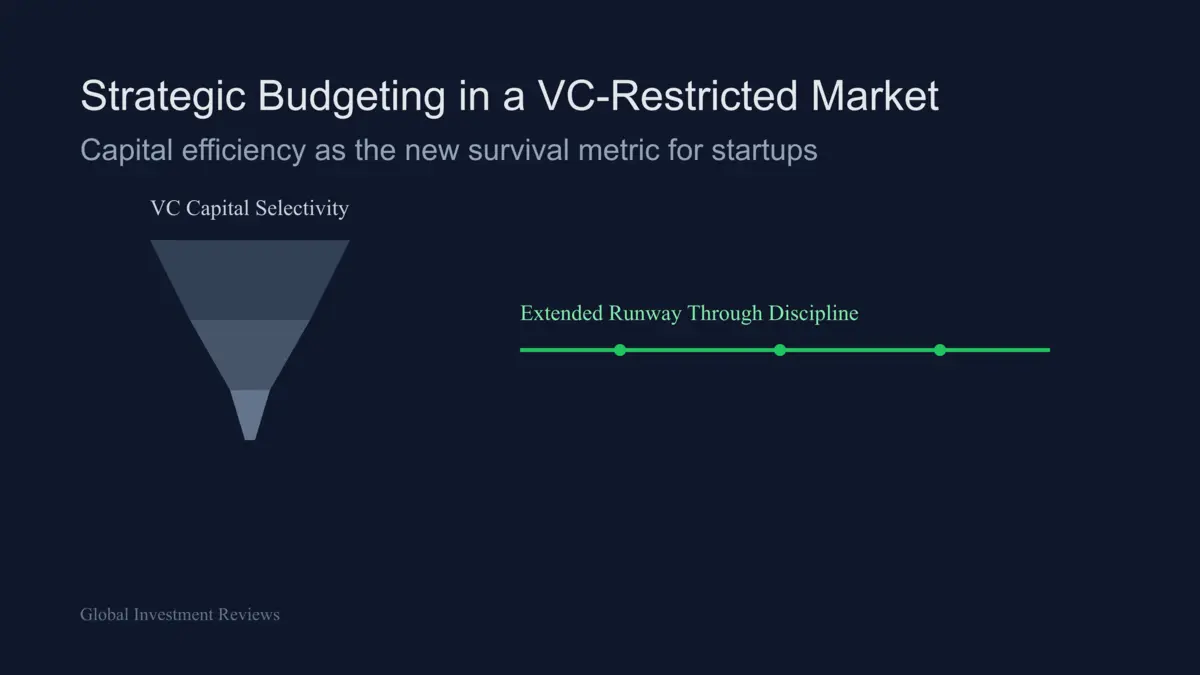
The era of cheap capital and "growth-at-all-costs" has transitioned from a standard operating procedure to a historical anomaly. For founders and CFOs, the current shift in the venture capital landscape is not a temporary market correction but a structural realignment of how private companies are valued and funded. When the cost of capital rises, the margin for operational error evaporates, making capital efficiency the primary survival metric for the foreseeable future.
The Macro Shift: A Fundamental Paradigm Shift in Venture Funding
The current scarcity in venture funding is rooted in a fundamental repricing of risk. As central banks moved away from zero-interest-rate policies, the discount rates applied to future cash flows increased, disproportionately impacting high-growth, pre-profitability startups. This macro environment has forced a pivot from liquidity-driven valuations to performance-driven fundamentals.
Investors have moved toward aggressive capital selectivity, favoring companies that demonstrate a clear path to self-sustainability. Modern venture strategy is no longer about the theoretical "exit" in a decade; it is about the resilience of the business model today. Slower exit environments—marked by a congested IPO pipeline and cautious M&A activity—have further tightened the spigot. Institutional investors are husbanding their dry powder for follow-on rounds in proven winners, leaving the broader market to contend with a significantly higher bar for fresh capital deployment.
In operational terms, a "VC-restricted" market is defined by friction. This friction manifests in extended fundraising cycles, where what was once a ninety-day process has morphed into a six-to-nine-month marathon. Due diligence is no longer a formality but an exhaustive forensic audit of unit economics and customer cohorts. Furthermore, the prevalence of internal bridge rounds—often structured with aggressive liquidation preferences—serves as a stark reminder that valuations are now pegged to public market comparable rather than the optimistic "mark-to-market" figures of years past.
See more: 2026 Financial Success Roadmap: The Ultimate Guide to Wealth
Tactical Mechanics: Treating Runway as a Strategic Asset
In a capital-flush market, runway is often viewed as a simple countdown timer. In a restricted market, runway management must be treated as a strategic asset. Every month of additional cash on hand represents increased leverage in negotiations. When a company is forced to raise capital with only three months of liquidity remaining, it is no longer a partner in a transaction; it is a distressed asset.
Resilient startups have abandoned incremental budgeting in favor of Zero-Based Budgeting (ZBB). This framework requires every department head to justify every dollar of expenditure for each new period, starting from a base of zero. This forces a radical transparency that exposes "zombie projects"—initiatives that were funded during periods of excess but no longer serve the core survival metric of capital efficiency.
A resilient budget is an elastic one. Strategic budgeting prioritizes variable cost structures over fixed, "sticky" costs. This involves favoring contractor agreements for non-core functions and utilizing success-based commission structures for sales teams. The goal is to ensure that if revenue underperforms, the burn rate can be adjusted downward within a single 30-day cycle.
Payroll can be one of a startup’s largest operating expenses, but its share of burn varies by sector, stage, geography and business model; an unsupported universal 80% benchmark should not drive hiring decisions. Resilient firms compare the fully loaded cost of a role with its expected contribution, then move from hiring ahead of the curve to just-in-time hiring where appropriate. This limits the "Default Dead" trajectory—a state where a company requires a fresh injection of capital simply to survive—and moves the firm toward being Default Alive.
Governance, Signaling, and the Architecture of Optionality
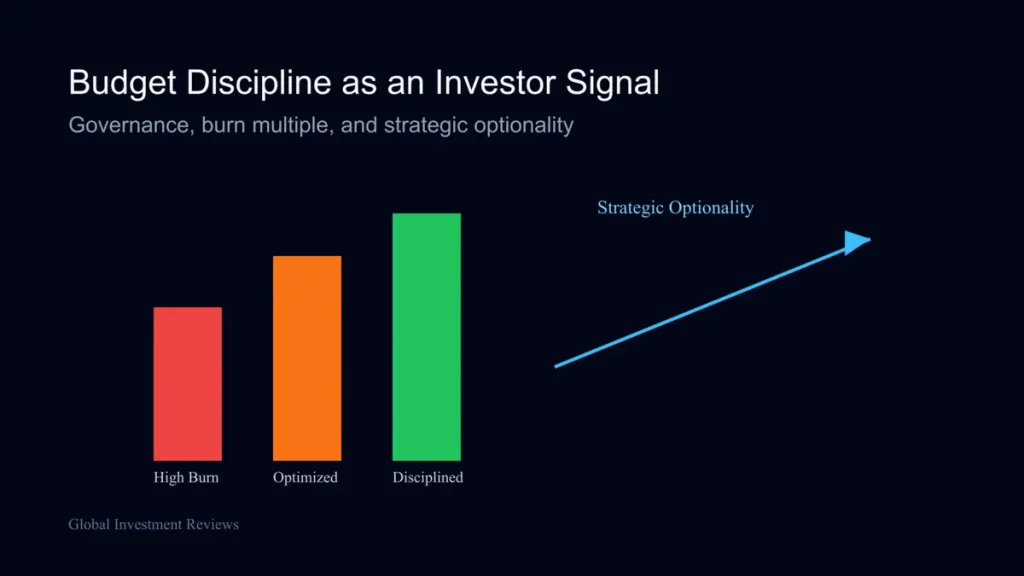
In a capital-constrained market, a budget is a declaration of corporate character. Disciplined budgeting functions as a high-fidelity investor signal, demonstrating management maturity and predictability. For a venture capitalist, a team that demonstrates forecast accuracy and a declining Burn Multiple is a team that can be trusted with a larger check.
Effective budget governance requires moving beyond the static annual plan toward real-time feedback loops. Board oversight now mandates a three-case model: the Base Case for attainable growth, the Upside Case for expansion, and the Survival Case for runway preservation. A disciplined leadership team identifies negative variances within weeks and has pre-determined triggers for corrective action.
The most profound benefit of financial discipline is the creation of strategic optionality. When a company is capital-efficient and possesses a long runway, it is no longer a "price taker." It gains the ability to wait for favorable market windows, the leverage to negotiate better terms, and the capacity to act as a consolidator in a distressed market.
Ultimately, strategic budgeting is a foundational leadership discipline. It requires the courage to say no to marginal opportunities and the intellectual honesty to value cash-on-hand over vanity metrics. The startups that emerge from this cycle as incumbents will be those that managed their resources with the highest degree of precision, ensuring their trajectory is determined by performance rather than the shifting tides of the venture market.
Disclaimer: This article is for informational and educational purposes only and does not constitute financial, investment, or legal advice.
A monthly runway review founders can operationalize
Track actual cash, committed but unpaid costs, expected collections, payroll, tax liabilities and debt service separately. Calculate runway using a realistic net burn rate, then stress-test delayed customer payments, churn, lower sales and an unexpected hiring or compliance expense. Revenue forecasts should be tied to observable pipeline stages and historical conversion rates rather than treating every opportunity as certain.
Set trigger points for spending decisions before cash becomes critical—for example, when collections slip or runway falls below the board's chosen threshold. Prioritize obligations that protect customers, legal compliance and core operations. A budget is useful only when owners review variances frequently and update assumptions as evidence changes.
Frequently asked questions
Is runway simply cash divided by last month's expenses?
That is a rough shortcut, but it can mislead if receipts, committed liabilities or spending are changing. Use a rolling cash forecast that reflects expected inflows and outflows.
When should a startup revise its budget?
Review it on a regular cadence and whenever material assumptions change, such as sales conversion, customer payment timing, hiring plans or financing availability.
Review checklist
- Separate fixed commitments from variable spend and tie revenue assumptions to signed contracts or observable pipeline evidence.
- Test collection delays, hiring commitments, debt service and the timing of future funding against available cash.
- Review the model frequently and label assumptions clearly; a runway projection is a scenario, not a guarantee of future solvency.
Practical checks for the user or business
Startup runway should be calculated from usable cash and a realistic net burn rate, with expected receipts distinguished from signed and collected revenue. Hiring plans, supplier commitments, financing conditions and a slower sales cycle can change how much time the company truly has.
The SBA guide is a US small-business resource for planning and finance; startup runway calculations are universal planning tools, but tax, employment and fundraising rules vary by jurisdiction. Read the source material: US Small Business Administration business guide.
Related Resources
Smart Money Management
Automated Budgeting: The 2026 Guide to AI Financial Orchestration
Compare the best automated budgeting AI apps of 2026 and learn how to find and stop the small spending leaks that quietly drain your money.

Company & Business
How to Verify a Company Profile Online: A Step-by-Step Guide
A step-by-step guide to verifying a company online: official registers, regulator checks, domain and people checks, sanctions lists and scam warning signs.

Company & Business
Inside Corporate Culture: What Really Drives Company Success
What corporate culture really is, what research says about its effect on results, and how to judge a company's culture as a job seeker or investor.
The information provided is for educational and informational purposes only and does not constitute financial, investment, tax, or legal advice.