
Sustainable Infrastructure Investment: The Institutional Mega-Guide
Explore sustainable infrastructure across energy, transport and utilities, including investment vehicles, policy drivers, valuation considerations and risks.
Fact Checked By: Mominur Rahman
The global investment landscape is undergoing a profound structural transformation, driven by a confluence of geopolitical shifts, technological innovation, and an undeniable imperative for climate action. Ten years ago, sustainable infrastructure was treated as a niche allocation, often relegated to impact-focused mandates or early-stage venture capital. Today, it is a strategic necessity, rapidly evolving into a core component of diversified institutional portfolios. The shift towards a decarbonized, resilient global economy is not merely an environmental aspiration; it represents one of the most significant capital reallocation events in modern financial history. Investors seeking durable returns, inflation protection, and long-term growth potential are increasingly turning their attention to the burgeoning opportunities within Sustainable Infrastructure Investment. This mega-article delves into the intricate macroeconomic underpinnings, investment theses, and actionable strategies for navigating this pivotal asset class.
To help institutional allocators and wealth managers navigate this evolving asset class, this comprehensive analysis breaks down the sustainable infrastructure ecosystem into actionable segments:
- Macroeconomic Drivers & Policy: Dissecting the core economic shifts, regulatory tailwinds (like the US IRA), and carbon-pricing mechanisms propelling the sector.
- Sub-Sector Profiles: Exploring distinct risk-reward profiles across clean energy, grid modernization, climate resilience, and green digital network infrastructure.
- Institutional Frameworks: Analyzing how global giants like BlackRock and Brookfield deploy private equity, green bonds, and Public-Private Partnerships (PPPs).
- Risk & Due Diligence: Providing a sophisticated framework to mitigate regulatory changes, technological obsolescence, and project execution risks.
- Market Allocation Strategies: Actionable deployment paths for both institutional mandates and high-net-worth (HNW) portfolios.
What Is Sustainable Infrastructure?
Sustainable infrastructure encompasses the planning, design, construction, operation, and decommissioning of physical and organizational structures that meet the needs of society without compromising the ability of future generations to meet their own needs. This includes renewable energy generation, energy storage, smart grids, sustainable transportation, water and waste management, green buildings, and climate-resilient infrastructure. These assets are characterized by their long operational lifespans, often stable cash flows, and alignment with environmental, social, and governance (ESG) principles.
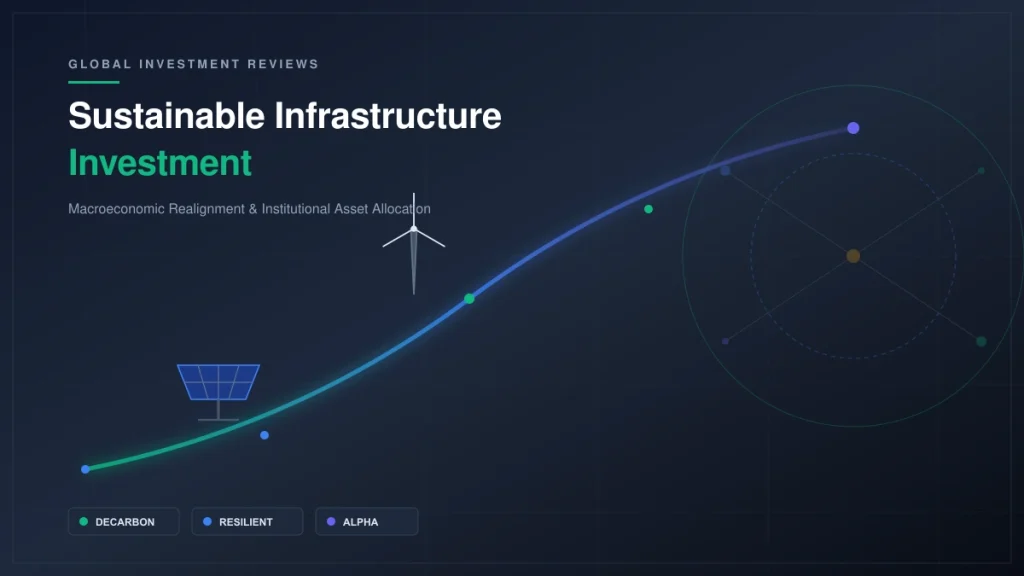
Strategic Allocations at a Glance
Core growth verticals defining the modern sustainable infrastructure landscape:
Utility-scale solar, wind, hydro, and geothermal deployments backed by multi-decade, inflation-indexed PPAs.
Grid-scale battery tech (e.g., Tesla Megapack) and smart transmission lines buffering renewable intermittency.
High-speed rail networks, public transit upgrades, and extensive EV charging grids de-linking growth from emissions.
Advanced wastewater treatment, desalination facilities, and circular economy infrastructure with inelastic demand.
Energy-efficient data centers, fiber-optic backbone assets, and sustainable 5G cell tower infrastructure.
Flood defense systems, coastal barriers, and resilient urban planning targeting localized systemic risk mitigation.
The Macroeconomic Imperative: Drivers of a New Investment Epoch
The transition to a sustainable global economy is no longer a distant ideal but an accelerating reality, propelled by a potent mix of policy mandates, technological advancements, and shifting societal values. This confluence creates a uniquely fertile ground for investment in sustainable infrastructure.
Policy Tailwinds and Regulatory Frameworks
Governments worldwide are increasingly recognizing the economic and social benefits of investing in green and resilient infrastructure. The policy landscape has shifted from aspirational targets to concrete legislative action, providing unprecedented clarity and incentives for private capital.
In the United States, the Inflation Reduction Act (IRA) of 2022 stands as a monumental piece of legislation, committing hundreds of billions of dollars in tax credits and incentives for renewable energy, electric vehicles, and energy efficiency. This act has fundamentally de-risked investments in solar, wind, and battery storage, offering long-term certainty for project developers and investors. Similarly, the European Union's Green Deal Industrial Plan aims to bolster the EU's net-zero technology manufacturing capacity, streamlining permitting processes and providing state aid flexibility. This aggressive stance is designed to counter global competition and accelerate the bloc's decarbonization efforts.
See more: Micro-Investing Apps: How to Build a Wealthy Portfolio with Small Change
Canada's Sustainable Finance Action Plan and Australia's Rewiring the Nation initiative, focused on upgrading the electricity grid for renewables, further underscore this global policy consensus. These frameworks are not merely subsidies; they are strategic industrial policies designed to catalyze private investment, create jobs, and foster technological leadership. According to the IEA World Energy Outlook 2023, global clean energy investment is projected to reach $1.8 trillion in 2023, largely driven by these policy interventions.
Technological Innovation and Cost Compression
The relentless march of technological innovation has dramatically altered the economics of sustainable infrastructure. Solar photovoltaic (PV) and wind power, once prohibitively expensive, are now the cheapest forms of new electricity generation in many regions. BloombergNEF data consistently shows levelized cost of electricity (LCOE) for utility-scale solar and wind falling by over 80% and 60% respectively over the last decade. This cost compression is not limited to generation; advancements in battery storage, smart grid technologies, and green hydrogen production are rapidly improving efficiency and scalability.
The advent of AI and IoT in grid management, predictive maintenance for wind turbines, and optimized energy consumption in smart buildings further enhances operational efficiency and asset longevity. These technological leaps are transforming what was once a niche, high-cost sector into a mainstream, competitive industry with compelling unit economics.
Demographic Shifts and Urbanization
Rapid urbanization, particularly in emerging markets, presents both a challenge and an opportunity. Cities are energy-intensive hubs, and their sustainable development is critical for global decarbonization. Investing in smart city infrastructure, efficient public transport, and decentralized renewable energy solutions within urban centers offers significant growth potential. Moreover, an increasingly environmentally conscious populace, particularly among younger generations, is driving demand for sustainable products, services, and infrastructure, creating a powerful social license for these investments.
GIR Investor Insight
The convergence of robust policy support and declining technology costs has created a 'golden era' for sustainable infrastructure investment. This isn't just about environmental impact; it's about investing in assets with predictable, inflation-linked cash flows, backed by government-mandated demand and technological superiority. The risk-reward profile has fundamentally shifted, making these assets increasingly attractive to institutional mandates.
- Policy Certainty: Long-term tax credits and subsidies de-risk capital deployment.
- Cost Competitiveness: Renewables now outcompete fossil fuels on LCOE.
- Scalability: Technologies are mature and ready for mass deployment.
The Investment Thesis: Durable Returns in a Volatile World
Investing in sustainable infrastructure offers a compelling value proposition, characterized by long-term stability, diversification benefits, and a hedge against inflation, making it particularly attractive in the current macroeconomic climate.
Stable, Predictable Cash Flows
Many sustainable infrastructure assets, such as renewable energy projects, operate under long-term power purchase agreements (PPAs) or feed-in tariffs. These contracts can run for many years, and some have 15–25-year terms, but contract length, indexation and revenue certainty vary by jurisdiction, buyer credit quality and contract design. This contractual stability is a significant draw for institutional investors like pension funds and insurance companies, which have long-duration liabilities. Water utilities, waste management facilities, and toll roads also exhibit similar characteristics, offering essential services with inelastic demand.
Inflation Hedge and Real Asset Characteristics
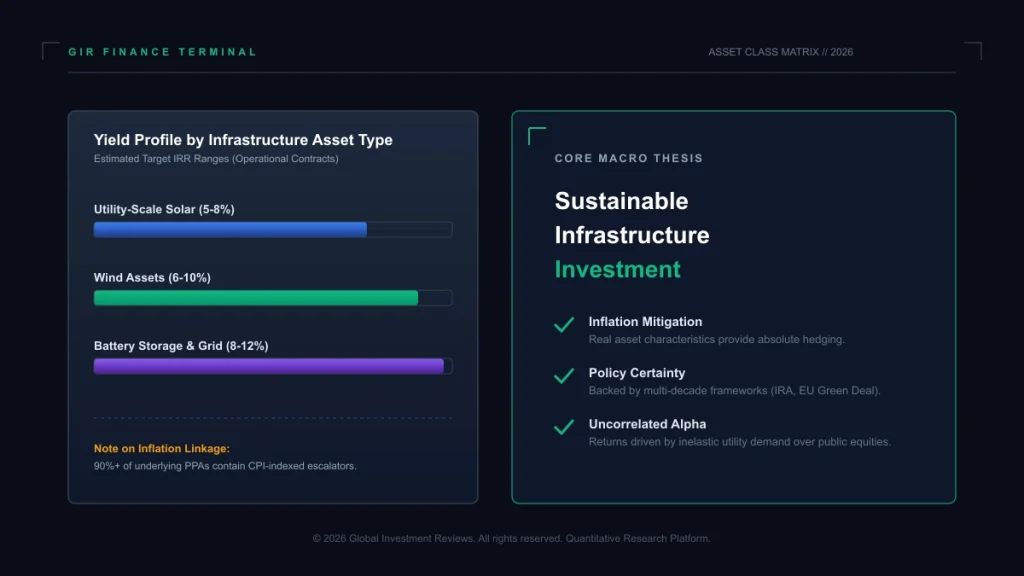
Sustainable infrastructure assets are real assets, meaning their value and income streams tend to be correlated with inflation. PPAs often include inflation escalators, and the underlying costs of operating these assets (e.g., land, construction materials) can also appreciate with inflation. Furthermore, once constructed, the marginal cost of producing energy from a wind turbine or solar panel is near zero, shielding operators from commodity price volatility that impacts fossil fuel generators. This makes sustainable infrastructure a potent tool for preserving capital and generating real returns in an inflationary environment.
Diversification Benefits
Adding sustainable infrastructure to a traditional portfolio of stocks and bonds can enhance diversification. These assets often have low correlation with broader equity markets, especially during periods of economic downturns, due to their essential service nature and contractual revenue streams. Their performance is more closely tied to specific regulatory environments, project execution, and long-term energy demand trends rather than short-term market sentiment. This can reduce overall portfolio volatility and improve risk-adjusted returns.
Growth Potential and Market Expansion
Global infrastructure investment needs are substantial, but headline totals depend on the geography, asset classes and time period included. This article does not attribute a US$90 trillion figure to the World Bank without a directly matching primary source. Investors should compare the scope and baseline of each estimate before using it to size a market opportunity.
Key Structural Risk
While the tailwinds are strong, investors must remain cognizant of structural risks. Policy reversal or instability, particularly in jurisdictions with shifting political landscapes, poses a material threat. Permitting delays and NIMBYism (Not In My Backyard) can also significantly impact project timelines and costs. Furthermore, technological obsolescence, while currently favoring renewables, could eventually pose a challenge if new, more efficient solutions emerge rapidly, though the long-term nature of these assets often allows for adaptation.
- Regulatory Uncertainty: Changes in subsidies or environmental regulations.
- Permitting & Siting: Delays and local opposition can inflate costs.
- Grid Intermittency: Managing renewable energy variability requires significant grid upgrades and storage, adding complexity and cost.
Regional Deep Dive: Policy Advantages and Market Dynamics
The investment landscape for sustainable infrastructure varies significantly by region, influenced by distinct policy frameworks, energy mixes, and market maturities. Understanding these nuances is crucial for strategic allocation. For related regional context, explore GIR’s analysis of the US–Canada energy corridor and global economic corridors.
United States: The IRA Catalyst
The Inflation Reduction Act has fundamentally reshaped the U.S. renewable energy market. The long-term, direct pay or transferrable tax credits for solar, wind, battery storage, and green hydrogen projects provide unprecedented certainty. This has spurred a wave of domestic manufacturing and project development. Key areas of focus include utility-scale solar and storage in the Sun Belt, offshore wind along the East Coast, and advanced manufacturing facilities for EV batteries and solar panels. The U.S. market offers scale, technological leadership, and a robust legal framework, making it highly attractive for large institutional investors.
United Kingdom: Offshore Wind Prowess and Grid Modernization
The UK has been a global leader in offshore wind development, boasting some of the largest operational projects worldwide. Its ambitious net-zero targets and Contracts for Difference (CfD) scheme provide a stable revenue mechanism for renewable energy generators. Beyond wind, the UK is investing heavily in grid modernization, energy storage, and nascent green hydrogen projects. While Brexit has introduced some regulatory complexities, the underlying commitment to decarbonization remains strong, offering opportunities in established renewable assets and emerging energy transition technologies.
Canada: Hydro Power, Carbon Pricing, and Critical Minerals
Canada benefits from a vast existing hydro power base, providing a stable foundation for its clean energy transition. The federal carbon pricing mechanism, coupled with provincial incentives, drives investment in renewable energy, energy efficiency, and carbon capture utilization and storage (CCUS). Canada is also strategically positioned in critical minerals, essential for battery manufacturing and other clean technologies, creating opportunities across the entire sustainable infrastructure value chain. The market is characterized by a strong regulatory environment and a sophisticated institutional investor base.
Australia: Solar Superpower and Export Hub
Australia possesses some of the best solar resources globally, positioning it as a potential renewable energy superpower. The "Rewiring the Nation" program is a significant commitment to upgrading its grid to handle a higher penetration of renewables. Beyond domestic consumption, Australia aims to become a major exporter of green hydrogen and renewable energy, leveraging its abundant resources and proximity to Asian markets. This presents opportunities in large-scale solar and wind farms, transmission infrastructure, and green hydrogen production facilities.
GIR Investor Insight
Our analysis at GIR Finance indicates that while all these regions offer compelling opportunities, the U.S. currently presents the most robust policy-driven tailwinds for new greenfield development due to the IRA's comprehensive incentives. However, the UK and Australia offer mature markets for offshore wind and solar respectively, with Canada providing a stable, diversified play across hydro and emerging CCUS. Regional diversification is key to mitigating policy-specific risks.
- U.S.: Strongest near-term policy catalyst (IRA).
- UK: Established offshore wind leadership.
- Canada: Hydro stability, critical minerals, carbon pricing.
- Australia: Solar export potential, grid modernization.
Valuation Metrics and Investment Vehicles
Valuing sustainable infrastructure assets requires a nuanced approach, combining traditional financial metrics with an understanding of regulatory frameworks and long-term societal trends.
Key Valuation Metrics
- Yield-on-Cost (YoC): Often used for operational assets, reflecting the initial investment cost relative to annual cash yield.
- Internal Rate of Return (IRR): Project-level IRR is crucial for greenfield developments, accounting for construction risk and development costs.
- EBITDA Multiples: Commonly used for operating companies or portfolios, comparing enterprise value to earnings before interest, taxes, depreciation, and amortization.
- Discounted Cash Flow (DCF): The fundamental valuation method, projecting future cash flows and discounting them back to present value, accounting for the long-term nature of these assets.
- ESG Premium: While difficult to quantify precisely, assets with strong ESG credentials may command a premium due to increased investor demand and lower cost of capital.
Investment Vehicles
- Direct Investments: Large institutional investors may directly acquire stakes in individual projects or portfolios. This offers maximum control but requires significant expertise and capital.
- Private Equity Infrastructure Funds: These funds pool capital from various limited partners to invest in a diversified portfolio of infrastructure assets. They offer professional management and diversification.
- Publicly Traded Infrastructure Funds/ETFs: Provide liquidity and diversification through exposure to listed infrastructure companies.
- YieldCos/Renewable Energy Trusts: Publicly traded companies that own and operate contracted renewable energy assets, distributing a significant portion of their cash flow to shareholders. Examples include Brookfield Renewable Partners and NextEra Energy Partners.
- Green Bonds: Fixed-income instruments specifically designed to fund environmentally friendly projects. These offer a liquid way to invest in sustainable initiatives.
| Asset Type | Typical Yield Range (Operational) | Key Revenue Driver | Risk Profile | Inflation Linkage |
|---|---|---|---|---|
| Utility-Scale Solar | 5-8% | Long-term PPAs, tax credits | Moderate (resource, policy, grid) | High (PPA escalators) |
| Onshore Wind | 6-9% | Long-term PPAs, CfDs | Moderate (resource, policy, grid) | High (PPA escalators) |
| Offshore Wind | 7-10% | Long-term CfDs, scale benefits | Higher (construction, marine, grid) | High (CfD escalators) |
| Battery Storage | 8-12% | Ancillary services, capacity markets | High (market volatility, technology) | Moderate (market-driven) |
| Water Utilities | 3-6% | Regulated tariffs, essential service | Low (regulatory, operational) | High (tariff indexation) |
Case Studies: Real-World Applications and Market Leaders
Examining leading players in the sustainable infrastructure space provides tangible examples of successful investment strategies and operational excellence.
- Brookfield Renewable Partners (BEP): A global leader in renewable power, BEP owns and operates a diversified portfolio of hydroelectric, wind, solar, and storage facilities across North and South America, Europe, and Asia. Their strategy focuses on acquiring and developing high-quality assets with long-term contracts, leveraging their operational expertise to enhance value. BEP exemplifies the YieldCo model, providing stable distributions to investors.
- NextEra Energy (NEE) & NextEra Energy Resources: NextEra Energy, through its subsidiary NextEra Energy Resources, is the world's largest generator of renewable energy from the wind and sun. They are at the forefront of integrating renewables with battery storage and developing innovative grid solutions. Their scale and technological prowess allow them to execute massive projects and benefit from economies of scale.
- Ørsted (ORSTED.CO): A Danish multinational power company, Ørsted has transformed from a fossil fuel-intensive utility to a global leader in offshore wind power. Their strategic pivot demonstrates the potential for incumbents to successfully transition and dominate the new energy landscape. They are known for their expertise in complex offshore project development and execution.
- Enphase Energy (ENPH): While not a direct infrastructure owner, Enphase is a critical technology enabler for distributed sustainable infrastructure. They develop microinverters, battery storage, and energy management systems for residential and commercial solar. Their growth highlights the importance of investing in the underlying technology that makes sustainable infrastructure more efficient and accessible.
- Tesla Megapack (Tesla.com/megapack): Tesla's utility-scale battery storage solution, Megapack, is a prime example of how energy storage is becoming a cornerstone of sustainable infrastructure. Projects utilizing Megapack, such as the Hornsdale Power Reserve in Australia, demonstrate the ability of large-scale batteries to stabilize grids, integrate higher levels of renewables, and provide critical ancillary services. This showcases the growing investment opportunity in energy storage as a standalone asset class.
- BlackRock Infrastructure Funds (BlackRock): Major asset managers like BlackRock have launched dedicated infrastructure funds, including those focused on sustainable assets. These funds provide institutional investors with diversified exposure to a range of sustainable infrastructure projects globally, managed by experienced teams. This trend underscores the mainstreaming of sustainable infrastructure as a recognized and sought-after asset class.
Best High-CPC Funds and Platform Options for Portfolio Allocation
For institutional and high-net-worth investors seeking efficient exposure to sustainable infrastructure, several high-quality funds and platforms offer compelling options. These typically feature robust management, diversified portfolios, and competitive fee structures.
Publicly Traded Funds and ETFs
- Vanguard FTSE Global All Cap ex US Index Fund ETF (VEU): While not exclusively sustainable infrastructure, VEU offers broad international equity exposure, including many companies that are significant players in the global sustainable infrastructure supply chain and development. For a more direct approach, Vanguard also offers ESG-focused ETFs that may include infrastructure components.
- Fidelity Global Clean Energy Fund (FSLEX): This actively managed fund invests in companies engaged in the clean energy sector globally, which naturally includes many sustainable infrastructure developers, operators, and technology providers. Fidelity's research capabilities provide active management oversight.
- iShares Global Clean Energy ETF (ICLN): A popular ETF that tracks an index of global companies involved in the clean energy sector. It offers diversified exposure to solar, wind, and other renewable energy technologies, including key infrastructure players.
- First Trust Global Wind Energy ETF (FAN): A more specialized ETF focusing specifically on companies involved in the wind energy industry, from turbine manufacturers to project developers and operators.
- Global X Lithium & Battery Tech ETF (LIT): While focused on materials, this ETF provides exposure to the critical components of energy storage, a rapidly growing segment of sustainable infrastructure.
Private Market Access Platforms
For investors seeking direct or semi-direct private market exposure, these platforms can facilitate access:
- BlackRock Alternatives (Infrastructure Debt & Equity Funds): As mentioned, BlackRock offers a suite of private infrastructure funds, including those with a strong sustainable focus. These are typically accessible to institutional and accredited investors.
- Brookfield Asset Management (Infrastructure Funds): Brookfield is one of the largest global investors in infrastructure, with dedicated funds that target renewable power, utilities, and other sustainable infrastructure assets. Their expertise in real assets is unparalleled.
- Stonepeak Infrastructure Partners: A leading private equity firm specializing in infrastructure investments, with a growing portfolio in renewable energy, digital infrastructure, and transportation.
- Macquarie Asset Management (Green Investments): Macquarie is a global leader in infrastructure investment and management, with significant expertise and funds dedicated to green infrastructure and the energy transition.
Brokerage Platforms for Access
High-net-worth individuals and smaller institutions can access many of these public funds and ETFs through mainstream brokerage platforms:
- Charles Schwab: Offers a wide range of ETFs and mutual funds, including many ESG and clean energy options. Their platform provides robust research tools and customer support.
- Fidelity: Known for its extensive fund offerings, Fidelity provides access to its own actively managed funds and a broad selection of third-party ETFs, including those focused on sustainable infrastructure.
- Vanguard: While primarily known for its low-cost index funds, Vanguard's platform allows access to a variety of ETFs, including those from other providers, enabling investors to build a diversified sustainable portfolio.
- Interactive Brokers: Favored by sophisticated investors for its low costs and extensive global market access, Interactive Brokers provides access to a vast array of ETFs, individual stocks, and other instruments, making it suitable for constructing a highly customized sustainable infrastructure portfolio.
| Fund/Platform Type | Pros | Cons | Typical Investor |
|---|---|---|---|
| Public ETFs (e.g., ICLN, FAN) | Liquidity, diversification, low cost, easy access | Market volatility, indirect exposure, less control | Retail, HNW, smaller institutions |
| Actively Managed Public Funds (e.g., FSLEX) | Professional management, potential alpha, diversification | Higher fees, manager risk, still public market exposure | HNW, family offices, smaller institutions |
| Private Equity Infrastructure Funds (e.g., BlackRock, Brookfield) | Direct asset exposure, illiquidity premium, operational control | High minimums, illiquidity, complex structures, higher fees | Institutional, UHNW, sovereign wealth funds |
| YieldCos (e.g., BEP) | Stable distributions, growth potential, public liquidity | Equity market correlation, interest rate sensitivity | Income-focused, HNW, institutions |
The Bottom Line
The allocation strategy to sustainable infrastructure should be tailored to an investor's liquidity needs, risk appetite, and investment horizon. For broad, liquid exposure, ETFs and actively managed public funds are suitable. For those with longer horizons and higher capital thresholds, private equity infrastructure funds or direct investments offer deeper value and potentially higher returns, albeit with illiquidity. A balanced approach often combines public and private vehicles to optimize for both liquidity and long-term capital appreciation.
- Diversify Across Technologies: Don't just focus on solar or wind; consider storage, grid, water, and waste.
- Geographic Sprawl: Leverage policy advantages in different regions.
- Blend Public & Private: Optimize for liquidity and return profiles.
- Due Diligence: Thoroughly vet management teams and project pipelines.
Infrastructure Yield & ESG Impact Calculator
Project long-term financial returns alongside carbon mitigation metrics.
Explore More Allocation Resources: Want to simulate customized capital projections across alternative sectors? Access our full suite of institutional-grade web models on the GIR Financial Tools Page.
Conclusion: A Strategic Imperative for the Modern Portfolio
The investment thesis for sustainable infrastructure is no longer nascent; it is robust, multifaceted, and underpinned by powerful, irreversible global trends. From the transformative policy incentives of the Inflation Reduction Act to the relentless decline in renewable energy costs, the macroeconomic environment is exceptionally conducive to this asset class. Investors are not merely funding environmental good; they are securing access to long-duration, inflation-hedged, and often contractually stable cash flows that can significantly enhance portfolio resilience and returns.
The GIR Research Desk views this macroeconomic shift as a generational opportunity, akin to the rise of digital infrastructure in the late 20th century. Ignoring the sustainable infrastructure megatrend is, in essence, ignoring a significant portion of future economic growth and value creation. As capital markets continue to price in climate risks and opportunities, assets aligned with the energy transition and climate resilience will increasingly command a premium.
For institutional investors, the integration of sustainable infrastructure into core allocations is becoming a strategic imperative, not just an ESG overlay. It offers a powerful antidote to market volatility, a hedge against persistent inflation, and a pathway to durable, real returns. High-net-worth individuals can access this opportunity through a growing array of public funds, specialized ETFs, and increasingly, through private market platforms. The journey towards a sustainable global economy is not just a future possibility, but the defining investment blueprint of our era.
Frequently Asked Questions
Sustainable infrastructure investment refers to allocating institutional capital into physical assets and organizational structures—such as renewable energy, smart grids, and water management—that support economic development while mitigating climate impact and adhering to strict ESG principles.
These real assets are inherently shielded from inflation because their primary revenue structures, like Power Purchase Agreements (PPAs) or regulated tariffs, typically feature built-in consumer price index (CPI) escalators. Furthermore, wind and solar operations face near-zero marginal fuel costs, protecting operators from commodity price shocks.
The U.S. Inflation Reduction Act of 2022 fundamentally transformed the landscape by providing long-term, transferable tax credits for clean energy deployment. According to data tracked at Global Investment Reviews, this policy framework has completely de-risked massive private capital allocation toward solar and battery storage projects.
Project-level returns for operational utility-scale solar vary with capital structure, financing costs, location, contract terms, merchant exposure, tax treatment and asset age. The previously stated 5%–8% range should be treated as illustrative rather than a verified market-wide benchmark; do not infer that every project has a predictable return.
Utility-scale batteries may earn revenue from ancillary services, capacity mechanisms and energy arbitrage where markets permit, but revenues vary with local market design, dispatch, degradation, grid connection, financing and competition. The previously stated 8%–12% yield is illustrative, not a verified universal benchmark.
Offshore wind returns depend on auction terms, power prices, financing, construction risk, transmission, operating costs and policy. The previously stated 7%–10% yield is illustrative, not a verified market-wide range; cite a dated dataset and define the return metric before using a benchmark.
The primary structural risks include severe permitting and siting delays (NIMBYism), unforeseen regulatory shifts or subsidy clawbacks in unstable political jurisdictions, and near-term constraints in local power grid interconnection capacities.
While large institutions make direct investments, individual investors can easily build exposure through liquid public vehicles like YieldCos (e.g., Brookfield Renewable Partners), specialized green bonds, and pure-play clean energy ETFs accessible via mainstream brokerage channels.
Regional diversification is vital to mitigate localized policy risks. For instance, blending the aggressive policy tailwinds of the U.S. market with the highly mature offshore wind framework of the UK and the stable hydro profile of Canada optimizes an infrastructure portfolio's risk-reward curve.
Greenfield projects (new developments) are valued primarily on aggressive project-level IRR to compensate for construction and permitting phase risks. Operational brownfield assets (existing infrastructure) are valued using Discounted Cash Flow (DCF) models and EBITDA multiples, reflecting stable, recurring cash distributions.
Project viability before projected returns
Sustainable infrastructure should be judged on delivered service and lifecycle economics as well as its environmental label. Construction impact, resilience, maintenance, affordability, community effects, offtake and the evidence behind claimed emissions benefits all belong in due diligence.
Related Resources
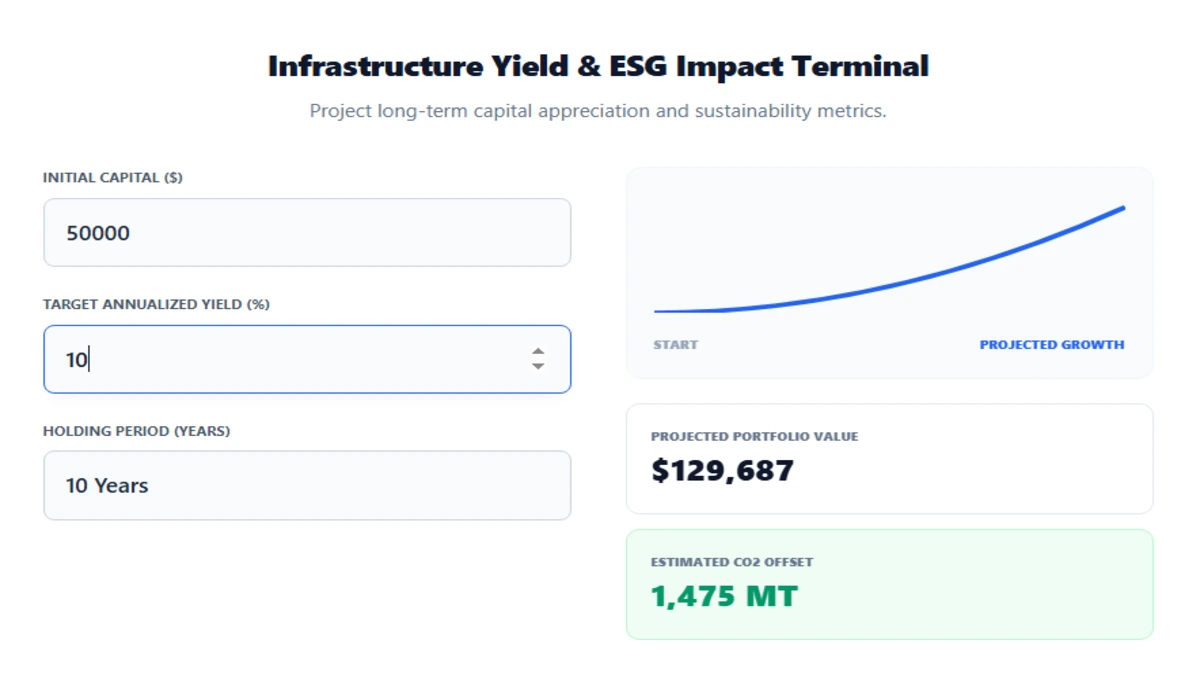
Sustainable Infrastructure Investment & ESG Yield Calculator
Model long-term portfolio yields and ESG carbon offset metrics with our institutional-grade sustainable infrastructure investment calculator. Free asset modeling asset.

International Banking
Cross-Border Payments Infrastructure 2026
Analyze evolving cross-border payments infrastructure, correspondent banking shifts, and liquidity management strategies for global institutions.

North America
US-Mexico Cross-Border Nearshoring Infrastructure
Analyze cross-border investment trends, industrial real estate demand, and supply chain infrastructure financing across the US-Mexico trade corridor. nearshorin
The information provided is for educational and informational purposes only and does not constitute financial, investment, tax, or legal advice.