
Oil Price Shocks and Portfolio Protection: A Risk Framework
A practical framework for assessing oil-price shocks, inflation exposure, sector sensitivity and portfolio resilience without relying on unverified live-market claims.
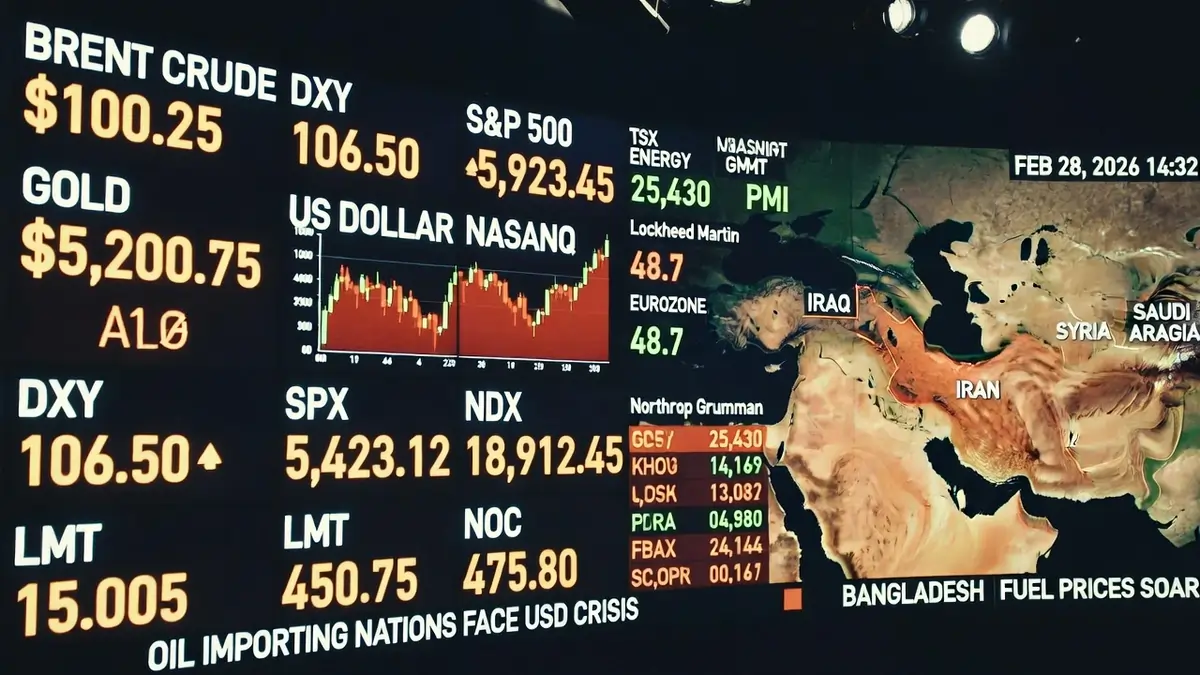
Oil, gold, currency and futures prices change throughout the trading day. This article focuses on how to think through an energy-price shock rather than providing live quotes. For a market comparison, use dated data for the same instrument and session, and distinguish spot prices, futures contracts and cash indices.
1. Energy Shock: Why $100 Oil Portfolio Protection Starts Here
Higher oil prices can feed into transport, heating and production costs, but the impact on headline inflation is not mechanical. It depends on how long the increase lasts, exchange rates, fuel taxes, subsidies, household consumption patterns and how much of the cost businesses pass on. A short spike can have a different effect from a sustained rise, so investors should compare the scenario with current official inflation and energy data rather than rely on a universal rule of thumb.
In Europe, a sustained energy-price shock could raise input costs and complicate the European Central Bank’s inflation-growth trade-off, but the effect on Germany’s PMI and the timing of any rate change depend on current data and cannot be inferred from an old forecast. The U.S. Energy Information Administration’s 6 October 2026 outlook reported that Brent spot prices averaged US$114 per barrel in September 2026; that is a dated monthly average, not a live quote or a forecast. Source: EIA, October 2026 Short-Term Energy Outlook. Treat US$100 oil as a scenario for stress-testing, not a standalone buy/sell signal.
2. Safe-Haven Rotation: Gold & DXY in $100 Oil Portfolio Protection Strategies
Gold and the US dollar can both attract safe-haven demand, but their responses vary with real yields, positioning, liquidity and the source of the shock. Gold and the US dollar can both attract safe-haven demand, but the relationship is not stable in every episode. Gold has no contractual yield, while a stronger dollar can tighten financial conditions for borrowers with dollar liabilities. Compare dated gold prices, real yields and the dollar index over the same period rather than assuming that either asset must rise.
3. Equity Dispersion: Where $100 Oil Portfolio Protection Wins & Loses
Equity markets can respond unevenly to the same geopolitical event. Energy producers may receive a revenue tailwind, while airlines, transport firms, chemicals businesses and other fuel-intensive companies may face higher costs. Defence contractors are affected by procurement cycles, contract margins and valuations—not simply by headlines. Before comparing returns, use the same session and distinguish index futures from the cash index.
European and Canadian markets can respond differently because their sector mixes, energy dependence, currencies and policy settings differ. For an investor measuring returns in another currency, exchange-rate moves can materially change the result. Compare the same time window and instrument type, then check whether the apparent difference comes from sector exposure, currency translation or the wider market.
See more: The Global Guide to International Tax Treaties and Double Taxation Avoidance
War-Time Asset Performance (February 28, 2026 Intraday)
| Asset / indicator | Data to check | Potential portfolio channel | Source to consult |
|---|---|---|---|
| Brent crude | Dated futures settlement and intraday high, including contract month and timestamp | Inflation expectations, energy-sector cash flow and transport costs | ICE Futures Europe / CME contract data |
| Gold futures | Dated contract, settlement price and timestamp | Real yields, safe-haven demand and USD moves | CME Group historical market data |
| US dollar index | Exact index contract and session close | Foreign-currency returns and funding stress | ICE U.S. Dollar Index futures data |
| Equity index futures | Contract month, timestamp and whether values are futures or cash index | Risk appetite, discount rates and sector rotation | Relevant exchange historical data |
| Energy / defence equities | Named securities, quote timestamp and whether price change is adjusted | Company-specific exposure; not a proxy for all sector constituents | Issuer filings and exchange quotes |
For any live-market comparison, use a dated primary-source record and note the instrument, contract month where relevant, time zone and settlement convention. This table is a research checklist, not a live market feed.
A practical portfolio stress test for an oil-price shock
- Energy exposure: Oil producers may benefit from higher realized prices, but outcomes depend on production costs, hedging, debt, taxes, regulation and valuation. Treat sector exposure as a scenario to analyse, not a universal overweight recommendation.
- Gold allocation: Gold can diversify some portfolios, but it produces no contractual income and can fall in value. Set any allocation from the investor’s goals, liquidity needs, risk tolerance and overall portfolio—not a fixed percentage from a general article.
- Defense-sector exposure: Defence companies face procurement, valuation, budget and execution risks. Assess individual filings and contract disclosures; do not assume a geopolitical event guarantees returns.
- Fixed-income duration: Higher energy prices can raise inflation risk, but bond prices also respond to growth, real yields, central-bank policy and term premiums. Stress-test multiple rate paths instead of making a blanket duration call.
- Volatility instruments: VIX options and leveraged volatility products are complex, can lose value rapidly and may not track an investor’s intended hedge over time. Explain payoff, decay, liquidity and maximum loss before considering them; they are not a default hedge for every investor.
- Liquidity buffer: Size cash reserves around expected spending, income stability, liabilities and risk tolerance. Avoid tying a general cash recommendation to an unsupported index level or market-timing target.
Geopolitical shocks rarely resolve cleanly. Operation Epic Fury may stay contained—or evolve into a multi-quarter regime shift. For $100 oil portfolio protection, position sizing and disciplined hedging remain your strongest edges.
See more: Strategic Budgeting for Startups: Maximizing Runway in a VC-Restricted Market
The useful question is not whether one headline predicts the next session. It is whether the portfolio remains resilient if energy prices stay elevated, retreat quickly or rise further. Review the assumptions periodically as new data arrives.
Portfolio review: a scenario-based checklist
Rather than treating a round-number oil price as a forecast, test how different energy-price paths would affect the portfolio. Separate direct exposure (energy producers and energy-linked funds) from indirect exposure through transport, airlines, chemicals, consumer spending and inflation-sensitive assets. Review position size, concentration, liquidity needs and the time horizon before changing allocations. A hedge should address a defined risk and have a known cost; it should not simply express a short-term market opinion.
For investors in the United States, United Kingdom, Canada and Australia, compare the currency of each holding with the currency of future liabilities. A portfolio can be directionally right about oil and still lose in its reporting currency. Use current market data and your own risk limits before acting.
Frequently asked questions
Does higher oil always benefit an energy investment?
No. Results depend on production costs, debt, hedging, taxes, capital spending, refining exposure and the price already reflected in the security. Review the business model rather than relying on the commodity price alone.
What is a sensible first step when energy volatility rises?
Run a downside and upside scenario against cash needs, portfolio concentration and investment horizon. Avoid making a portfolio-wide change based on one headline or an unverified price target.
Before changing a portfolio, check the evidence
Build at least three scenarios: energy prices retreat, remain elevated, or rise further. For each one, consider the likely effect on inflation, consumer demand, company margins, interest rates and the currency in which you measure returns. The aim is not to forecast a single outcome; it is to find exposures that could cause an unacceptable loss if your main assumption proves wrong.
- Use dated data from the relevant exchange, government statistics agency or company filing.
- Separate direct energy exposure from indirect exposure through transport, manufacturing and household spending.
- Check the cost, liquidity and maximum loss of a hedge before using it.
- Revisit concentration and cash needs before making changes based on a single news event.
This material is educational and is not individual financial advice. Investment decisions should reflect personal circumstances and independent research.
Related Resources
Geopolitical Impact
Military Conflict and Markets: How Geopolitical Shocks Reach Portfolios
How geopolitical shocks move markets: seven transmission channels, lessons from 1973 to 2022, and a scenario framework for investors instead of predictions.
Commodities
Master the global commodities market with GIR. Get expert analysis on Gold, Oil, and Metals. Learn to hedge inflation and grow your wealth. Start trading today!
Investment Research Tools
Explore practical, transparent investment research tools for portfolio allocation, stock comparisons, risk and return, correlation, rebalancing, fee impact, and position sizing.
The information provided is for educational and informational purposes only and does not constitute financial, investment, tax, or legal advice.