
Global Mobility · Global Horizons · Asian Dynamics
Foreign Investment in Vietnam: A Strategic Analysis of the Last Decade (2014-2026)
How foreign investment in Vietnam evolved from 2014 to 2026: key FDI trends, major sectors and data-driven insights for global investors.
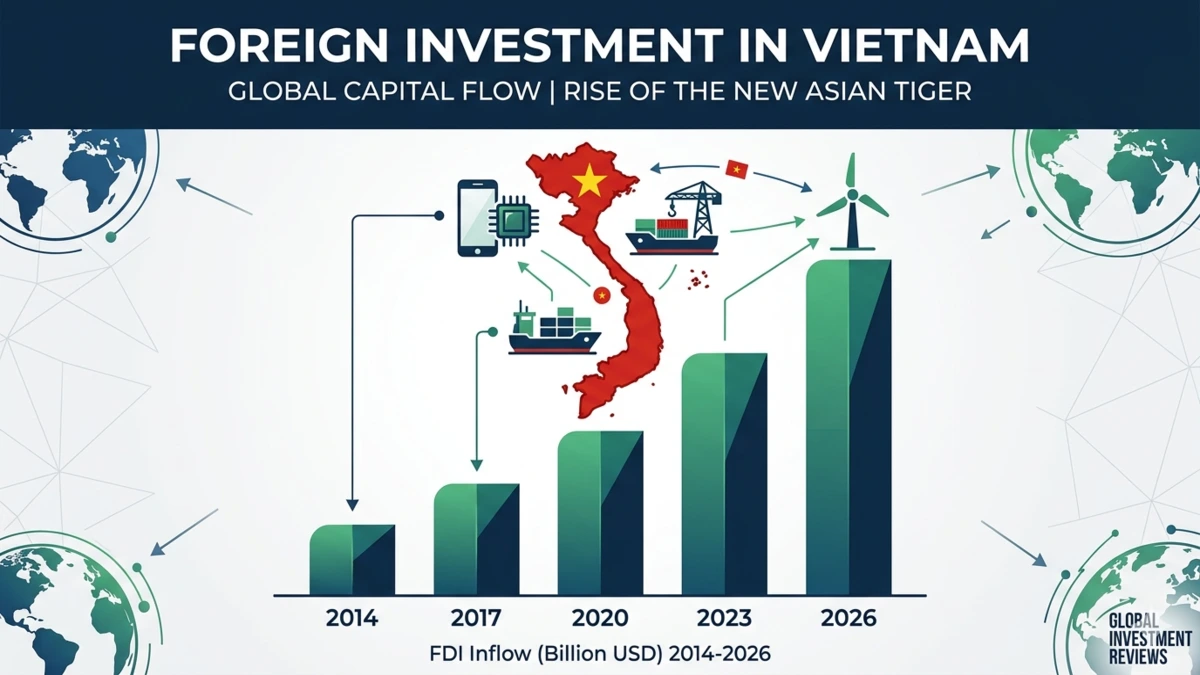
Vietnam is no longer just an "emerging market"—it has become a global manufacturing powerhouse. For institutional and retail investors looking at Southeast Asia, the trend of foreign investment in Vietnam represents a unique case study in resilience and strategic transition.
The "China Plus One" Catalyst
One of the most significant real-world examples of Vietnam’s success is Samsung. Samsung operates major smartphone manufacturing facilities in Vietnam, making the country an important part of its production network. The precise share of global smartphone output produced there varies by year and product and should not be stated without a dated company source. When global trade tensions between the US and China escalated, companies like Apple (via Foxconn) and Intel shifted their focus, ensuring that foreign investment in Vietnam didn't just look for "cheap labor," but for stability and a tech-ready ecosystem.
Key Takeaways: Vietnam Investment Outlook
- ✓ Strategic Tech Hub: Vietnam has successfully transitioned from a low-cost manufacturing base to a high-value electronics and semiconductor hub (e.g., Samsung and Intel's massive presence).
- ✓ Recent FDI performance: Vietnam’s official statistics distinguish registered inward investment from disbursed FDI, and the two series can move differently. Use the dated 2024–2025 figures below rather than treating a 2026 record as established before the year has ended.
- ✓ Trade Advantage: Participation in major FTAs like the EVFTA and CPTPP gives Vietnam a competitive edge in global export markets over its regional peers.
- ! Investor Caution: Infrastructure bottlenecks and the need for a more skilled technical workforce remain the primary long-term challenges.
A Decade of Growth: FDI Data Analysis
To understand the scale of this transformation, we must look at the numbers. The following table highlights how foreign capital has consistently flowed into the country, even during the global pandemic.
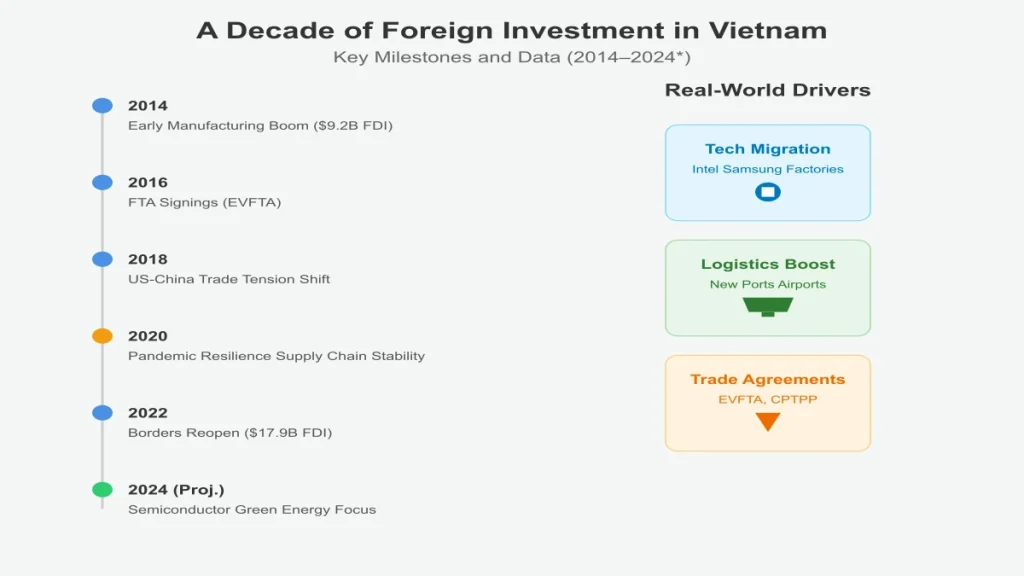
Table: Vietnam Annual Foreign Direct Investment (FDI) Inflows
Data correction: The previous table combined values that were not traceable to one consistent series and included an unverified 2026 estimate. The official measures below keep disbursed FDI separate from total registered inward investment; these are different measures and must not be compared as if they were the same flow.
| Reference period | Disbursed FDI | Total registered inward investment | Primary source |
|---|---|---|---|
| 2024 | US$25.35 billion; +9.4% year on year | US$38.23 billion; about −3% year on year | Vietnam MPI, 2024 FDI report |
| 2025 | US$27.62 billion; +9.0% year on year | US$38.42 billion; +0.5% year on year | Vietnam National Statistics Office, 2025 results |
Sources: World Bank Open Data, General Statistics Office (GSO) of Vietnam, and IMF Country Reports.
Why Investors are Choosing Vietnam: Real-World Drivers
1. Strategic Trade Agreements
Unlike many of its neighbors, Vietnam has been aggressive in signing Free Trade Agreements (FTAs). The EU-Vietnam Free Trade Agreement (EVFTA) phases out tariffs on roughly 99% of tariff lines over the agreement’s implementation schedule (not immediately on every product), making the country a magnet for European capital.
See More: How to Invest in USA Stock Market as an American in 2026
2. The Tech Migration
The shift from "Stitching to Soldering" is real. Intel’s largest chip assembly and test plant in the world is located in Ho Chi Minh City. This has created a "clustering effect," attracting further specialized foreign investment in Vietnam from semiconductor giants and AI hardware developers.
3. Infrastructure & Logistics
Vietnam’s infrastructure pipeline includes major airport, port, road and logistics projects. Project budgets, public-investment plans and total infrastructure needs are different measures; this article does not retain the previously stated infrastructure total because a directly matching current primary-source series was not confirmed.
The Road Ahead: Challenges and Risks
A professional analysis is never one-sided. While the growth is impressive, investors must monitor:
- Infrastructure Gaps: Rapid growth is putting pressure on the power grid.
- Skilled Labor Shortage: Demand for AI and Semiconductor engineers is outstripping supply.
- Bureaucracy: Despite reforms, administrative procedures can still be time-consuming.
Final Thoughts from Global Investment Reviews
Vietnam represents a "long-game" opportunity. Its integration into the global supply chain is now a structural reality. For those diversifying a portfolio, the data suggests that foreign investment in Vietnam will continue to be a cornerstone of Southeast Asian economic growth for the next decade.
What is your take on Vietnam's market potential for 2026? Let us know in the comments below.
Investor due diligence: from market thesis to execution
Investors assessing Vietnam should separate the long-term market thesis from the feasibility of a specific project. Validate the proposed business line, foreign ownership rules, licensing route, land-use or lease arrangements, tax treatment, hiring needs, currency exposure and ability to repatriate proceeds with qualified local advisers. The correct analysis depends on sector, legal entity, location and investor nationality; a general country overview cannot substitute for transaction-specific advice.
Build a current evidence pack using official investment and statistical agencies, published regulations and the target company's audited records where available. Record the date and definition of every statistic, and stress-test the project against slower demand, supplier disruption, higher financing costs and delays in permits or infrastructure.
Frequently asked questions
Can one foreign-investment structure work for every sector in Vietnam?
No. Permitted activities, ownership limits, licenses and operating requirements can vary by sector and project. Confirm the rules in force for the exact activity before committing capital.
Which sources should investors verify first?
Start with Vietnam's relevant government investment, business-registration, tax and statistics authorities, then corroborate legal interpretation with qualified local counsel and independent diligence.
Review checklist
- Add company-level licensing records, realised project data or sector-specific disclosures where a headline FDI trend is driving the conclusion.
Country and market due diligence
A decade-long foreign-investment analysis must distinguish realised investment from announcements and compare data on consistent definitions and periods. Sector mix, licensing, infrastructure, currency movements and policy changes all affect whether a headline inflow translates into a viable investment opportunity.
Related Resources
Asian Dynamics
Vietnam Country Profile and Economic Overview: A Strategic Guide for Investors
Discover the ultimate Vietnam Country Profile and Economic Overview. Learn about its history, borders, major cities, and why it is a global investment hotspot.

Financial Protection
Corporate Foreign Exchange Risk Mitigation Strategies
Explore advanced corporate foreign exchange risk mitigation strategies, currency hedging instruments, and balance sheet protection for global firms.
Asian Dynamics
The Ultimate Investment in Singapore Guide: 10-Year Trends & Strategies for High Returns
Discover the Investment in Singapore Guide by Global Investment Reviews. Explore officially reported FDI data, tax-free growth, and residency through investment.
The information provided is for educational and informational purposes only and does not constitute financial, investment, tax, or legal advice.