
Global Mobility · Passport Index & Mobility
Golden Visas Explained: How Residency and Citizenship by Investment Work
How golden visas work, which programmes have closed or tightened, and the tax, due diligence and policy risks to understand before investing.

What golden visas are, and what they are not
A "golden visa" is a residence permit, or sometimes citizenship, granted in return for a qualifying investment in a country. Two broad types exist. Residency by investment (RBI) gives the right to live in a country, usually for a renewable period, and may lead to permanent residence or citizenship after years of residence. Citizenship by investment (CBI) grants a passport directly, with no or little residence required. They are different products with different risks, and the rules have changed repeatedly in recent years, mostly toward tougher conditions or closure.
The routes usually offered
- Real estate purchase above a minimum value.
- Investment funds that invest in local companies or property, held for a set period.
- Business investment or job creation.
- Government bonds or deposits in the country.
- A non-refundable contribution to a national development fund, mainly in CBI programmes.
How much programmes have changed
| Country or scheme | What happened |
|---|---|
| Portugal | Ended the real estate route for new applicants in October 2023, while investment-fund and other routes remained available |
| Spain | Abolished its golden visa for new applications in April 2025 |
| Greece | Raised minimum property investment thresholds in 2024, to 800,000 euros in the most popular areas and 400,000 euros elsewhere |
| Ireland | Closed its Immigrant Investor Programme in 2023 |
| United Kingdom | Closed the Tier 1 Investor visa in 2022 after concerns about illicit money |
| Cyprus | Ended its citizenship by investment scheme in 2020 |
| Malta | Its citizenship by investment scheme was challenged by the European Commission and, in 2025, the EU's Court of Justice ruled against it |
| United States | The EB-5 programme has existed since 1990, with a standard minimum investment of 1.05 million dollars, or 800,000 dollars in targeted areas, following 2022 reforms |
| Caribbean CBI countries (Antigua and Barbuda, Dominica, Grenada, St Kitts and Nevis, St Lucia) | Offer passports through a donation or real estate purchase, and have faced pressure from the US, UK, EU and Canada over due diligence and visa-free travel |
Because programmes change, treat any list of "best" visas as a snapshot. Always check the current rules on the official immigration website of the country and not only on an agent's page.
The risks that matter
1. Policy risk
Governments can close or change a route. Applicants who have invested but not yet been approved are exposed. Check whether the rules protect pending applications and what happens to your investment if a programme ends.
2. Due diligence and rejection
Authorities carry out background checks, including source-of-funds checks. A weak paper trail for your money is a common reason for delays or rejection. Keep records of how wealth was earned and taxed.
3. Tax residency
Becoming a resident can make you tax resident, which may affect worldwide income and gains. Some countries also have exit taxes or tax citizens wherever they live, such as the United States. Many programmes require little time in the country, but local tax rules may count other connections. Get tax advice in both your current and new country before you apply.
4. Travel access
A residence permit in a Schengen country allows travel in the Schengen area but does not give a right to work or live in other EU countries. Citizenship passports vary in how many countries allow visa-free entry, and those arrangements can change if a country is seen to abuse its programme.
5. Investment risk
Many routes require buying property or holding a fund for years. Real estate may be hard to sell, and funds carry the risk of loss. A visa should not be the main reason to buy an asset.
6. Reputation and compliance
The OECD has published lists of residence and citizenship schemes it considers risky for the Common Reporting Standard, because they can be used to hide assets from tax authorities. Banks and employers may also ask more questions of people who have recently acquired citizenship by investment.
A sensible process
- Define the purpose: travel, family, safety, tax planning, business, or a plan B. Different goals suit different programmes.
- Check the government's official rules, thresholds and processing times.
- Calculate the total cost: investment, government fees, due diligence, legal and agent fees, and the cost of exit.
- Take independent legal and tax advice, not only from someone paid on completion.
- Prepare your source-of-funds documentation early.
- Plan your exit: what you will do if the property cannot be sold or the programme changes.
For specific country comparisons, see our guides to the top European residency programmes, the lowest-cost citizenship programmes, financial planning for dual citizens and digital nomad and startup visas.
Frequently asked questions
Does a golden visa give me the right to work?
It depends on the country. Many give the right to live there but not to work for a local employer, and some allow self-employment or running a business.
How long until a golden visa becomes citizenship?
Only if the country's naturalisation rules allow it, usually after several years of actual residence, language tests and other requirements. Many holders never qualify because they do not spend enough time there.
Is the money refundable?
Donations are not. Property and some fund investments can be sold or redeemed after a holding period, but the result depends on the market and the fund.
Are golden visas legal?
Yes, where governments offer them, but they are controversial and subject to increasing scrutiny by international bodies, including the EU and the OECD.
Sources and further reading
- European Commission, reports on investor citizenship and residence schemes, on commission.europa.eu.
- OECD, Residence/Citizenship by Investment Schemes and the Common Reporting Standard, on oecd.org.
- US Citizenship and Immigration Services, EB-5 Immigrant Investor Program, on uscis.gov.
- The official immigration authority of each country you are considering.
Programme rules change often and affect you personally; confirm current rules and take independent legal and tax advice before investing. This article is general information, not legal or tax advice.
Related Resources

Digital Nomad & Startup Visas
Digital Nomad and Startup Visas: How to Choose the Right Route
Compare digital nomad and startup visas: typical requirements, tax and social security pitfalls, and a checklist for choosing the right route.
Investment Migration
Top 5 European Residency Programs 2026: The Ultimate Investor’s Guide
Compare 2026 European residency-by-investment programs, their costs and their routes towards citizenship, before choosing your Plan B.
Investment Migration
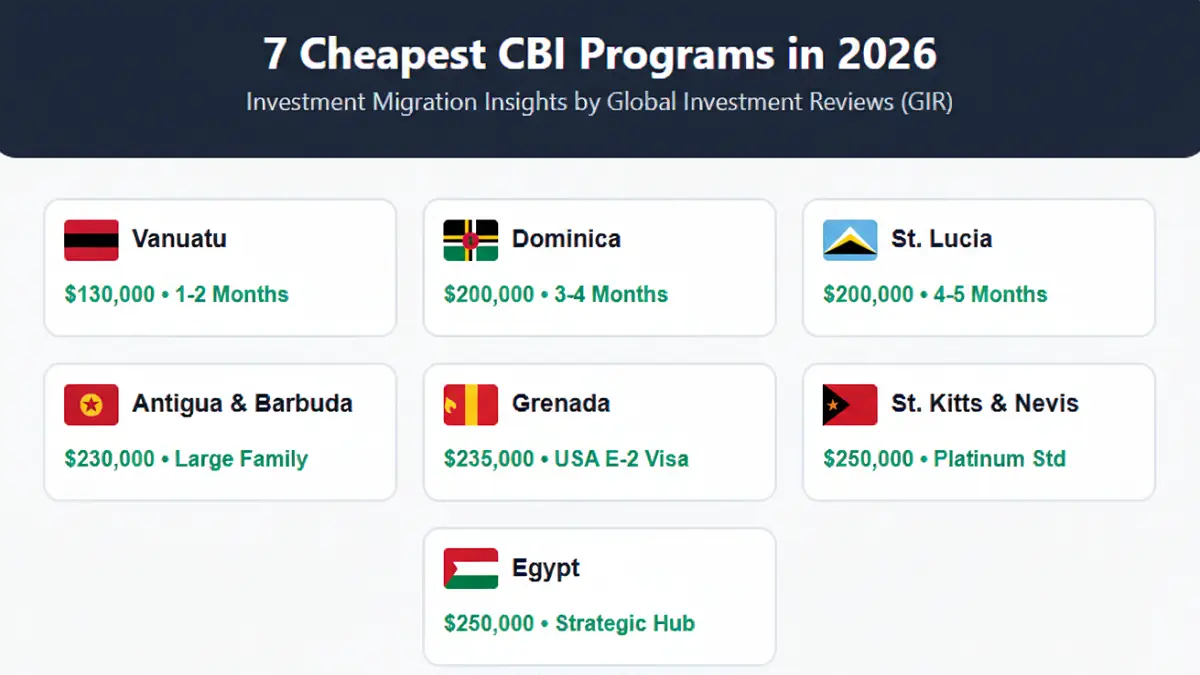
07 Cheapest Citizenship by Investment (CBI) Programs in 2026: A Global Investor’s Guide
Compare citizenship-by-investment programs by minimum contribution, eligibility and due diligence. Verify current rules and total fees before applying.
The information provided is for educational and informational purposes only and does not constitute financial, investment, tax, or legal advice.