
Global Mobility · Investment Migration
Top 5 European Residency Programs 2026: The Ultimate Investor’s Guide
Compare 2026 European residency-by-investment programs, their costs and their routes towards citizenship, before choosing your Plan B.
The global landscape of "Plan B" residency has shifted decisively. As we move through 2026, the era of easy real-estate-for-residency is largely in the rearview mirror, replaced by a sophisticated, capital-productive model favored by Brussels. For the savvy investor, navigating the Top 5 European Residency Programs 2026 is no longer just about buying a condo in the sun; it is a strategic maneuver involving asset allocation, tax optimization, and long-term family security in a volatile world.
While stalwarts like Spain have shuttered their investor visas entirely as of April 2025, several high-value corridors remain. These programs have survived EU-wide crackdowns by pivoting toward "productive" capital—funds, startups, and historical restorations. This guide provides the definitive breakdown of where to deploy capital for the best residency outcomes this year.
1. Hungary: The Guest Investor Program (GIP)
In 2026, Hungary has emerged as the premier "entry-level" European residency. Launched to replace its previous bond scheme, the Guest Investor Program (GIP) offers a unique 10-year residency permit, providing a level of stability that few EU nations can match.
The Investment
By 2026, the direct residential real estate route has faced administrative pauses, making the Real Estate Investment Fund the primary vehicle.
- Minimum Investment: €250,000 in a regulated real estate fund (registered with the Hungarian National Bank).
- Processing Time: processing times vary with documentation, due diligence and the current authority workload; check the official programme authority for current estimates.
- Official Source: Hungarian Ministry of Interior / NDGAP (National Directorate-General for Aliens Policing).
Key Benefits
- The 10-Year Permit: While Portugal or Greece require renewals every 2–5 years, Hungary grants a 10-year permit from the start.
- Zero Stay Requirement: Investors are not required to reside in Hungary, though it serves as a robust base for Schengen travel.
- Corporate Tax Perks: Hungary maintains one of the lowest corporate tax rates in the EU at 9%, attracting many digital entrepreneurs.
2. Greece: The "Innovation & Conversion" Golden Visa
Greece remains the most popular destination in the Mediterranean, but the rules changed significantly in late 2024 and 2025. In 2026, the market is split between high-entry luxury real estate and high-value "restoration" projects.
The Investment
- €800,000: For prime real estate in the "High Zone" (Athens, Thessaloniki, Mykonos, Santorini).
- €400,000: For standard residential properties in the "Middle Zone" (Regional Greece).
- €250,000: The Strategic Exception. Available for commercial-to-residential conversions or the restoration of "listed" (historical) buildings.
- Processing Time: Varies by case; confirm the current official processing estimate.
- Official Source: Enterprise Greece / Ministry of Migration and Asylum.
Key Benefits
- Yield-Heavy Real Estate: The conversion projects at €250k are often located in up-and-coming Athenian neighborhoods, offering high rental yields for the student and digital nomad markets.
- Three-Generation Inclusion: You can include your spouse, children up to age 21, and both sets of parents.
- Path to Citizenship: Naturalisation may be available after seven years of qualifying legal residence if the applicant meets statutory residence, language, civic-knowledge and other requirements; a Golden Visa alone does not guarantee citizenship.
3. Portugal: The Diversified Fund Route
Portugal’s Golden Visa survived its "extinction" scare by removing the real estate option entirely. In 2026, it is exclusively a Capital Markets program, attracting investors who prefer regulated financial instruments over physical property management.
The Investment
- Minimum Investment: €500,000 in qualifying Portuguese Venture Capital (VC) or Private Equity (PE) funds.
- Requirements: Funds must be domiciled in Portugal and have at least 60% of their capital invested in domestic companies.
- Processing Time: Varies; processing estimates and backlogs can change. Check current AIMA guidance.
- Official Source: AIMA (Agency for Integration, Migration and Asylum) / CMVM (Portuguese Securities Market Commission).
Key Benefits
- Citizenship is separate from residency: A Golden Visa does not itself grant citizenship. Under Portugal’s Organic Law No. 1/2026, the general residence period for naturalisation is 10 years for most foreign nationals and 7 years for EU and Portuguese-speaking-country nationals, subject to the law’s other conditions and applicable transition rules. The Golden Visa has separate minimum-stay rules. Source: Portugal Organic Law No. 1/2026
- Asset Diversification: Many 2026 funds focus on high-growth sectors like renewable energy, sustainable agriculture, and AI startups, providing a hedge against traditional real estate volatility.
4. Malta: The Permanent Residence Program (MPRP)
Malta offers the most robust "Permanent" status in the list. While other programs grant renewable permits, the MPRP provides a Certificate of Permanent Residency that does not expire as long as you maintain the initial conditions.
The Investment (Total Capital Outlay)
Malta’s MPRP cost depends on family size and whether the applicant rents or buys qualifying property. Current published requirements include a €60,000 administrative fee, a €37,000 government contribution and a €2,000 donation, plus either qualifying rent of at least €14,000 per year for five years or a qualifying property purchase of at least €375,000. These are minimum published requirements, not a complete all-in quote. Source: Residency Malta Agency
- Published fee schedule: €37,000 government contribution plus a €60,000 administrative fee and a €2,000 NGO donation; property and other costs are additional.
- Philanthropic Donation: €2,000 to a local NGO.
- Annual rent: Qualifying rented property must meet the current minimum annual rent of €14,000 and be retained for at least five years, under the published programme criteria.
- Asset evidence: Applicants must show capital assets of at least €500,000, including €150,000 in financial assets, or at least €650,000, including €75,000 in financial assets, under the current published programme criteria.
- Official Source: Residency Malta Agency.
Key Benefits
- Lifetime Status: No biennial renewals or re-applications.
- English as an Official Language: Simplifies legalities, banking, and education for the whole family.
- Financial Stability: Malta is one of the EU’s fastest-growing economies with a highly regulated banking sector.
5. Italy: The Investor Visa (La Dolce Visa)
Italy’s program has gained significant momentum in 2026, particularly for North American and Asian high-net-worth individuals (HNWIs) seeking a sophisticated European lifestyle combined with aggressive tax incentives.
The Investment
- €250,000: Investment in an "Innovative Startup."
- €500,000: Investment in a limited company (S.p.A. or S.r.l.).
- €2,000,000: Government Bonds (BTPs).
- Processing Time: Varies; confirm current timing with the official Italian Investor Visa Committee.
- Official Source: MIMIT (Ministry of Enterprises and Made in Italy).
Key Benefits
- Flat-tax regime: For individuals transferring tax residence to Italy from 1 January 2026, the substitute tax on qualifying foreign-source income is €300,000 per tax year; qualifying family members included in the regime are generally subject to €50,000 each. Eligibility, excluded income and conditions matter, so this is not a blanket tax on every kind of foreign income. Source: Italian Budget Law 2026
- Investor-visa processing: Pre-approval timelines depend on application completeness and current processing capacity. Do not assume a 30-day decision; confirm current timelines with the official Italian Investor Visa Committee before making commitments.
2026 Comparison Table: At a Glance
How to read these ranges: For Top 5 European Residency Programs 2026: The Ultimate Investor’s Guide, these figures are illustrative planning ranges, not independently established market-wide averages or forecasts. Before applying the ranges in Top 5 European Residency Programs 2026: The Ultimate Investor’s Guide, check the observation date, scope and relevant fees or contract terms against the cited source.
| Program | Min. Investment | Primary Asset Type | Processing Time | Citizenship eligibility (general) |
| Hungary | €250,000 | Real Estate Fund | Varies | 10-year permit; citizenship rules separate |
| Greece | €250,000 | Property Conversion | Varies | Generally 7 years’ legal residence, conditions apply |
| Portugal | €500,000 | VC / PE Funds | Varies | 10 years general / 7 years EU-CPLP; transition rules |
| Malta | Costs vary by property route and family | Outlay (Contrib/Rent) | Varies | No automatic citizenship |
| Italy | €250,000 | Innovative Startup | Varies | Generally 10 years for non-EU nationals; conditions apply |
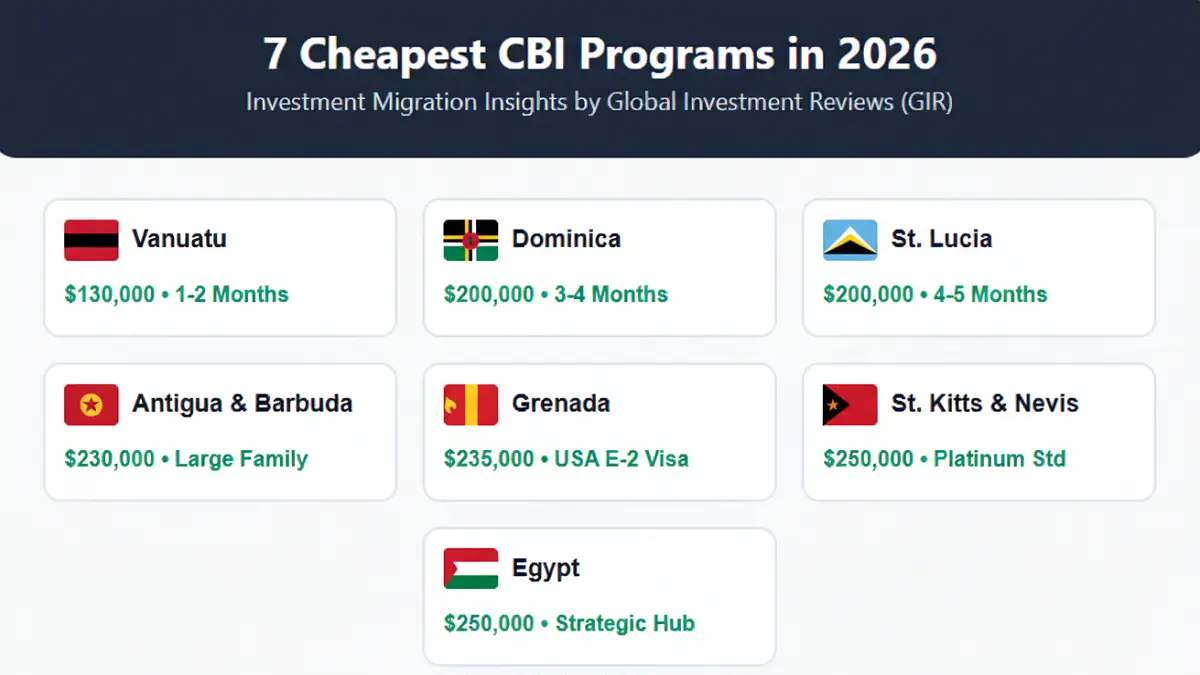
See more: 07 Cheapest Citizenship by Investment (CBI) Programs in 2026: A Global Investor’s Guide.
Strategic Investor Insights for 2026
When evaluating the Top 5 European Residency Programs 2026, the focus must move from "entry price" to "exit strategy" and "tax residency."
- Fund vs. Brick-and-Mortar: In 2026, fund-based residency (Portugal, Hungary) is generally more liquid and hands-off. However, property-based residency (Greece) offers a tangible asset that you can inhabit or rent out for euro-denominated income.
- The EU Regulatory "Sword of Damocles": The European Commission continues to pressure member states to end "passive" investment visas. This means programs with "productive" components—like Italy’s startup route or Greece’s restoration route—are less likely to be suddenly terminated.
- Tax Sequencing: Do not treat an investor visa as automatic tax residence. If you become an Italian tax resident, the optional flat-tax regime for qualifying foreign-source income is subject to detailed conditions and, for new transfers from 1 January 2026, the annual substitute tax is €300,000 for the main applicant and €50,000 per qualifying family member. Obtain advice based on the current law and your actual income sources.
Migration planning is often about finding the right balance between cost and benefits. To compare your options further, read our detailed guide on the 7 cheapest citizenship programs worldwide."
FAQ: Frequently Asked Questions
1. Is the Spain Golden Visa still available in 2026?
No. Spain formally closed its investor visa program in April 2025. Investors seeking Mediterranean residency have largely shifted their attention to Greece or Italy.
2. Can I live in any EU country once I have residency in one?
No. Your residency card allows you to travel visa-free throughout the 29 Schengen countries for 90 days every 180 days. To live and work permanently in a different EU country, you generally must reside in your host country for 5 years to gain "EU Long-Term Resident" status.
3. Which program has the lowest total cost?
In terms of non-recoverable costs, Malta is often the most affordable (around €150k total). However, Hungary’s €250k fund is an investment where you retain the principal, making it potentially cheaper in the long run if the fund performs well.
4. What is the "Commercial-to-Residential" conversion in Greece?
This is the 2026 "sweet spot." It allows you to invest only €250,000 anywhere in Greece, provided the building was previously commercial (like a warehouse or office) and is being converted into apartments.
5. How difficult is the language test for citizenship?
In Portugal, the A2 level is required—this is basic conversational proficiency. In Greece and Italy, the requirements are generally higher (B1), reflecting a move toward stricter integration standards.
Sources & Further Reading (Verified 2026 Data)
- Hungary: Enter Hungary Official Portal (NDGAP) – Guidelines on the Guest Investor Permit (GIP).
- Greece: Enterprise Greece - Golden Visa Rules – Detailed breakdown of the €250k/€400k/€800k zones.
- Portugal: AIMA (Agency for Integration, Migration and Asylum) – Updates on Golden Visa fund requirements and backlog management.
- Malta: Residency Malta Agency (MPRP) – Official checklist for Permanent Residence via contribution.
- Italy: Ministero delle Imprese e del Made in Italy (MIMIT) – The "Nulla Osta" portal for Italian Investor Visas.
Jurisdiction, rights and reporting checks
Residency programmes change in eligibility, fees, renewal rules and rights, and residence is not the same as citizenship or tax residence. Compare the current official conditions for the applicant and family rather than ranking programmes on the basis of a single advertised amount.
Related Resources
Investment Migration
07 Cheapest Citizenship by Investment (CBI) Programs in 2026: A Global Investor’s Guide
Compare citizenship-by-investment programs by minimum contribution, eligibility and due diligence. Verify current rules and total fees before applying.

Financial Protection
Cross-Border Tax Residency Audits
Navigate complex cross-border tax residency audits and mitigate permanent establishment risks with advanced international compliance strategies.

Investment Migration
Cross-Border Wealth Migration 2026 Strategy
Explore Cross-Border Wealth Migration strategies for international retirement, asset protection, tax compliance, and multi-jurisdictional portfolios.
The information provided is for educational and informational purposes only and does not constitute financial, investment, tax, or legal advice.