Live ETF Performance Monitor
Stop guessing your portfolio's future. Get real-time ETF tracking & expert analysis by GIR Finance. Beat the market average. See the top performers now!
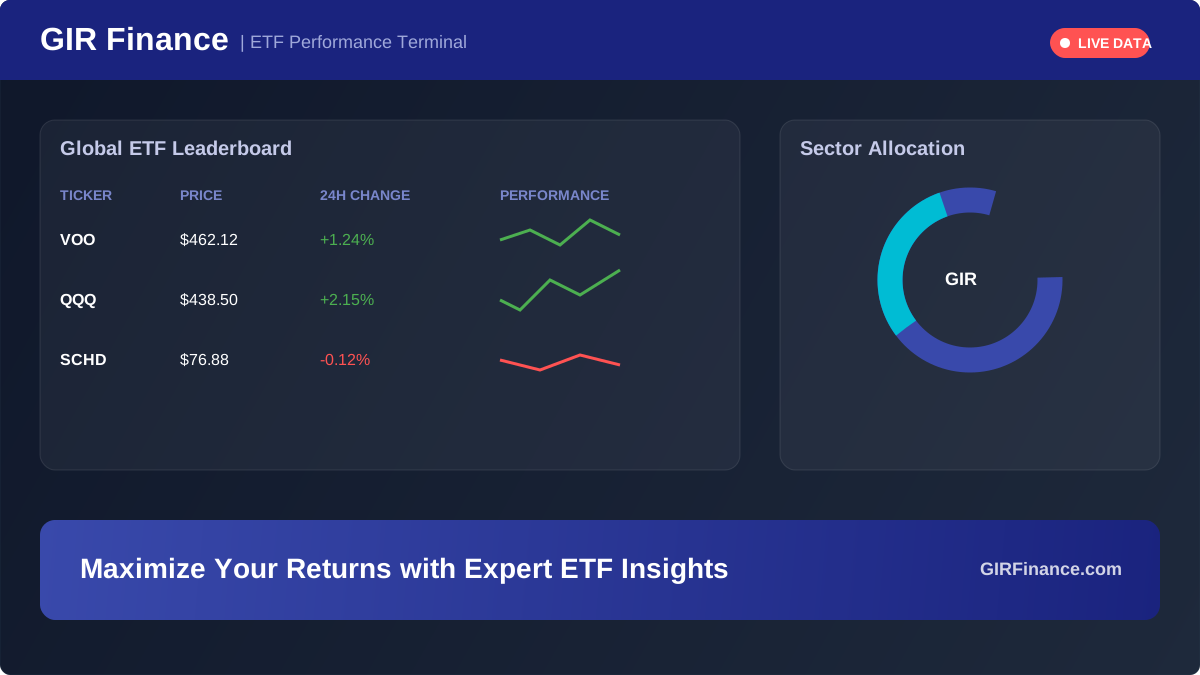
Global ETF Monitor
Live performance of top Exchange Traded Funds. Click for analysis.
Mastering ETF Investments: A Strategic Framework for Long-Term Growth
Analytical Insights from the GIR Finance Research Desk
In the modern financial landscape, the difference between a high-performing portfolio and a stagnant one often comes down to asset structure. At GIR Finance, we observe that the most resilient portfolios in the US and European markets share a common pillar: Exchange-Traded Funds (ETFs). Unlike individual stock picking, which subjects capital to idiosyncratic risk, ETFs offer a systematic approach to capturing broader market movements with surgical precision.
Enhance Your ETF Research
Get access to TradingView's institutional-grade charting and real-time ETF screeners to master your portfolio strategy.
Claim Your $15 CreditThe Science of Diversification: Why ETFs Outperform
The efficiency of ETF investing is more than just a market trend; it is backed by decades of financial econometrics and strategic asset allocation. As a core component of a total return strategy, ETFs function as a robust shield against market volatility. At its heart lies the Modern Portfolio Theory (MPT): by holding a diversified basket of assets, an investor can significantly mitigate unsystematic risk—the risk unique to a single company—without compromising expected returns.
The Passive Advantage
Data from the S&P Indices Versus Active (SPIVA®) scorecard consistently demonstrates that over long horizons, active fund managers struggle to beat their benchmarks. For instance, in the US market, over 85% of large-cap active managers underperformed the S&P 500 over a 10-year period. This reality has shifted the institutional focus toward low-cost, index-tracking ETFs as the primary vehicle for capital appreciation.
Efficiency and the Expense Ratio
One of the silent killers of wealth is the management fee. At GIR Finance, we emphasize the "Cost-Benefit Ratio." A mutual fund with a 1% expense ratio might seem small, but compounded over 20 years, it can consume nearly 20% of your total portfolio value. In contrast, top-tier ETFs often carry ratios as low as 0.03%, allowing compounding interest to work entirely in your favor.
From Theory to Practice: Global ETF Benchmarks
To understand the practical application of these theories, let’s analyze three critical sectors that are currently shaping the global investment environment in 2026.
1. The Core Growth Pillar (Broad Market ETFs)
Instruments that track the S&P 500, such as VOO (Vanguard S&P 500 ETF), remain the gold standard for long-term growth. They provide exposure to the 500 largest US companies, ensuring that your investment is fueled by the most dominant players in the global economy, from technology giants to healthcare innovators.
2. The Yield Engine (Dividend Appreciation ETFs)
For investors focused on cash flow, dividend-focused ETFs like SCHD (Schwab US Dividend Equity ETF) apply a rigorous screening process. They don't just look for high yield; they look for companies with sustainable earnings growth and strong balance sheets and It is a important thing. This "Quality Factor" in investing acts as a defensive shield during periods of high interest rates or economic cooling.
3. The Innovation Frontier (Thematic Tech)
Thematic investing allows for concentrated exposure to specific secular trends, such as AI-driven infrastructure or Renewable Energy. While these offer higher alpha potential, the GIR Finance research team advises balancing these with broad-market holdings to mitigate the volatility inherent in emerging technologies.
Strategic Selection: The GIR Finance 3-Point Checklist
Before integrating an ETF into your strategy, it is essential to look beyond the ticker symbol. Our analysts recommend evaluating three technical metrics:
- Liquidity and Bid-Ask Spreads: High trading volume ensures you can enter and exit positions without significant slippage costs.
- Tracking Error: This measures how closely the ETF follows its underlying index. A high tracking error can indicate poor fund management or hidden costs.
- Tax Efficiency: Especially for US-based investors, the unique "in-kind" creation and redemption process of ETFs makes them superior to mutual funds in minimizing capital gains taxes.
Research Standards & Global References
The insights provided by GIR Finance are cross-referenced with data and methodologies from the world’s leading financial authorities:
- BlackRock I-Shares Investment Institute: Insights on global capital allocation and macro trends.
- Morningstar Manager Research: Quantitative analysis of fund sustainability and risk metrics.
- Federal Reserve Economic Data (FRED): Real-time monitoring of interest rate impacts on equity valuations.
- CFA Institute Research: Guidelines on ethical portfolio management and diversification theories.
Global markets move fast, but a sound strategy moves faster. For real-time monitoring and advanced asset analytics, utilize the GIR Finance ETF Terminal.
Strategic Investor FAQ
The main difference lies in liquidity and cost structures. ETFs (Exchange-Traded Funds) trade on stock exchanges like individual shares throughout the day at market prices, whereas mutual funds are priced only once at the end of the day. At GIR Finance, we’ve found that ETFs typically offer significantly lower expense ratios and superior tax efficiency for long-term holders.
Liquidity ensures you can enter or exit a position close to its Net Asset Value (NAV). High liquidity results in tighter bid-ask spreads, which minimizes transaction slippage. Our monitor prioritizes high-volume ETFs to ensure users aren't penalized by the hidden costs often found in low-liquidity niche funds.
Yes, if the underlying securities within the ETF pay dividends, the fund typically distributes those earnings to its shareholders. Specialized ETFs, such as Dividend Appreciation Funds, are strategically engineered to target companies with a proven track record of increasing their payouts over time.
The expense ratio is the annual fee taken from your investment. While a 1% fee may seem marginal, compounded over 20 years, it can erode nearly 20% of your potential portfolio growth. GIR Finance advocates for institutional-grade indexing, where ratios often remain below 0.10%.
No investment is entirely risk-free. However, ETFs utilize 'Modern Portfolio Theory' to mitigate idiosyncratic risk through broad diversification. While market-wide volatility persists, owning a basket of hundreds of assets prevents the total capital loss that can occur with individual stock failures.